In today’s live event industry, lighting design is no longer only about brightness, color, and movement. It is also about speed, flexibility, safety, and efficiency. From concerts and festivals to weddings, churches, clubs, theaters, touring productions, exhibitions, and outdoor commercial events, lighting teams need control systems that can respond quickly to changing stage layouts and performance requirements. This is why wireless dmx stage lighting has become an increasingly important solution for modern lighting projects.
Traditional wired DMX systems are reliable and familiar, but they also bring obvious limitations. Long cable runs take time to install. Signal cables can create messy stage environments. Large venues may require complicated cable routing across trusses, stages, walls, and audience areas. For temporary events, rental companies often spend a lot of labor time on laying, taping, protecting, checking, and removing DMX cables. In some venues, running cables is simply inconvenient or unsafe.
Wireless DMX technology changes the way lighting professionals think about stage control. By replacing long signal cables with stable wireless transmission, lighting designers can place fixtures more freely, reduce setup time, keep the stage cleaner, and create flexible lighting systems for both indoor and outdoor projects. When combined with battery-powered fixtures, wireless DMX can even create a truly cable-free lighting experience: no signal cable and no power cable.
This article focuses on three important points behind modern wireless DMX systems: frequency hopping technology, battery-powered cooperation, and transmission distance comparison between 2.4G and UHF wireless technology. For lighting professionals, understanding these points can help you choose the right dmx lighting controller, plan a better wireless system, and operate your stage lighting control panel with more confidence.
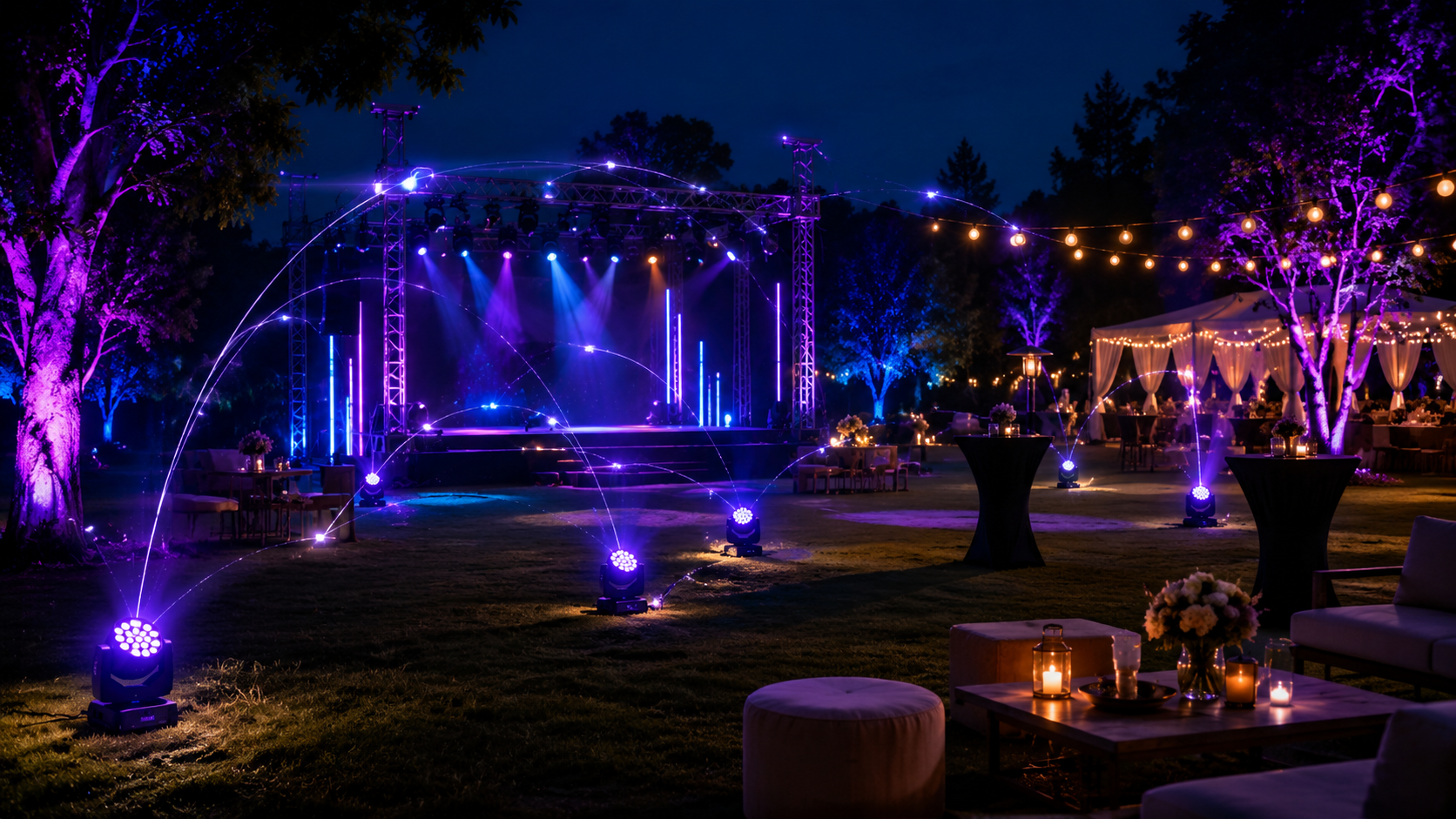
1. Why Wireless DMX Matters in Modern Stage Lighting
DMX512 has long been the standard control protocol for professional stage lighting. In a traditional system, the lighting console or dmx lighting controller sends control data through DMX cables to fixtures such as moving head lights, LED PAR lights, wash lights, pixel bars, strobes, lasers, blinders, and effect lights. Each fixture receives its address and responds according to the programmed signal.
This system works well, but modern event environments have become more complex. Many projects require fast installation, flexible fixture placement, temporary structures, outdoor stages, multiple performance zones, architectural lighting points, and interactive show areas. In these situations, wireless control becomes very useful.
With wireless dmx stage lighting, the control signal can travel from the transmitter to one or multiple receivers without physical DMX signal cables. The transmitter is usually connected to the lighting console, dmx lighting controller, or stage lighting control panel. The receiver is connected to the fixture or built into the lighting fixture itself. Once paired correctly, the wireless system sends DMX data in real time.
For rental companies, wireless DMX can reduce labor costs. For event planners, it can make the venue look cleaner. For lighting designers, it allows more creative fixture placement. For outdoor events, it can reduce the risk of cable damage caused by crowds, weather, vehicles, or complex terrain. For battery lights, it creates a very convenient solution for weddings, banquets, product launches, and temporary installations.
Wireless DMX is not designed to replace every wired DMX system in every situation. Wired DMX is still excellent for permanent installations, large touring systems with fixed cable infrastructure, or highly controlled environments. However, wireless DMX gives lighting professionals another powerful choice. It is especially valuable when time, flexibility, clean appearance, or difficult cable routing is a major concern.
2. Frequency Hopping Technology: The Secret of Stable Wireless Signal
One of the biggest concerns people have about wireless systems is signal stability. In real event environments, there may be many sources of wireless interference. Wi-Fi routers, mobile phones, Bluetooth devices, wireless microphones, LED screens, video transmission systems, and other stage equipment may all operate in nearby frequency ranges. A simple wireless system that stays on only one fixed frequency may suffer from interference, signal drops, or delayed response.
This is where frequency hopping technology becomes important.
Frequency hopping means that the wireless DMX system does not stay on one single frequency all the time. Instead, it quickly changes or “hops” between different frequency channels during operation. If one frequency channel becomes crowded or disturbed, the system can move to another cleaner channel. This helps maintain a stable signal even in complicated wireless environments.
For wireless dmx stage lighting, stable signal is extremely important. A lighting show depends on accurate timing. When the lighting console sends a command, the fixture should respond immediately. A moving head should pan and tilt at the correct time. A strobe should flash exactly on the beat. A color change should match the music cue. A blackout should happen instantly. If the wireless signal is unstable, the show may look unprofessional.
Frequency hopping helps reduce this risk. By continuously avoiding congested channels, the system improves anti-interference performance. This is especially useful in crowded event spaces such as concerts, clubs, exhibitions, TV studios, corporate events, and festival stages where many wireless devices operate at the same time.
A good wireless DMX system should also have fast pairing, low latency, reliable synchronization, and stable data transmission. The goal is not only to make the signal wireless, but to make the wireless signal feel as dependable as a cable. When the lighting operator uses the stage lighting control panel, every command should be transmitted smoothly to the fixtures.
In practical use, lighting technicians should still follow good wireless planning habits. The transmitter should be placed in a suitable position with a clear transmission path whenever possible. Metal structures, thick walls, LED screens, and large crowds can affect wireless signal quality. Receivers should be positioned carefully, and important fixtures should be tested before the show. Frequency hopping gives the system stronger stability, but professional setup and testing are still necessary.
For touring and rental companies, this technology is especially helpful because every venue is different. One day the show may be in a hotel ballroom. The next day it may be in a theater, outdoor plaza, church, club, or exhibition hall. The wireless environment changes from place to place. Frequency hopping allows the system to adapt better to these changing conditions.
3. Wireless Signal + Battery Power: The Real Meaning of “True Wireless”
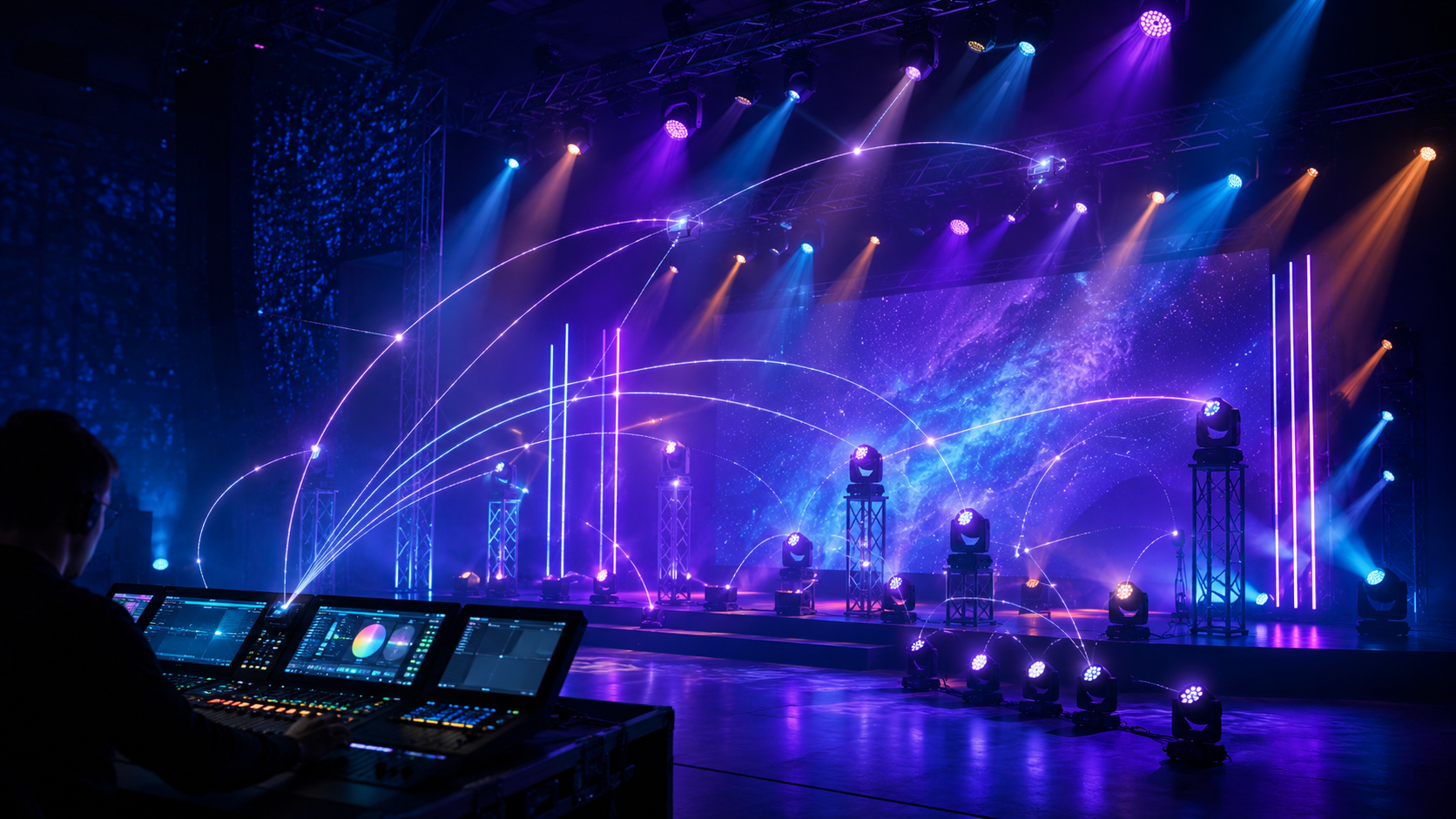
Wireless DMX solves the signal cable problem, but if the lighting fixture still needs a power cable, the system is not completely wireless. This is why battery-powered lighting fixtures are so important. When wireless DMX is combined with battery-powered fixtures, the result is a true wireless lighting setup: no DMX signal cable and no power cable.
This is especially valuable for uplighting, wedding lighting, banquet hall decoration, outdoor garden events, temporary exhibitions, product launches, fashion shows, and mobile DJ setups. Battery-powered LED PAR lights, battery wash lights, battery pixel tubes, and compact wireless fixtures can be placed almost anywhere. They can highlight walls, columns, trees, stages, entrances, photo areas, display booths, and architectural details without visible cables.
For event companies, this creates several advantages.
First, installation becomes much faster. Technicians do not need to run long DMX cables from fixture to fixture. They also do not need to search for power outlets at every lighting position. Fixtures can be placed, powered on, paired with the wireless transmitter, addressed, and controlled from the dmx lighting controller.
Second, the event space looks cleaner. For weddings and high-end corporate events, appearance matters. Visible cables on the floor can damage the visual quality of the venue. They can also create safety risks. A clean wireless setup looks more professional and elegant.
Third, fixture placement becomes more flexible. Designers can place lights in areas where cables would be difficult to run. This gives more creative freedom. Lights can be placed around a garden, beside a stage, under a table, near a backdrop, around a dance floor, or along a walkway.
Fourth, teardown becomes easier. After the event, the team can quickly collect the battery-powered wireless fixtures without removing long cable runs. This saves time and reduces labor pressure, especially for rental companies that need to move equipment quickly between events.
The combination of wireless dmx stage lighting and battery power is also useful in venues where cable installation is restricted. Some hotels, churches, museums, heritage buildings, and luxury venues do not allow cables to be taped across floors or attached to walls. A battery-powered wireless system can solve many of these problems.
However, battery cooperation also requires planning. The lighting team should check battery capacity, runtime, charging time, brightness mode, power consumption, and event duration. A fixture running at full brightness may consume battery faster than one running in a lower output mode. RGBWA UV color mixing, white output, strobe effects, and constant high-intensity operation may all affect runtime.
Professional users should prepare enough charging time before the event. For long events, backup fixtures or charging plans may be needed. The battery level should be checked during setup, before doors open, and during breaks if possible. Wireless control gives freedom, but battery management ensures reliability.
A true wireless system is not only about convenience. It changes the workflow of event lighting. Instead of designing around cable routes, lighting designers can design around visual impact. They can think first about where the light should be placed, what mood it should create, and how it should respond to the show. Then wireless DMX and battery power make that design easier to realize.
4. 2.4G Wireless DMX: Flexible, Common, and Practical
Many modern wireless DMX systems use 2.4G wireless technology. The 2.4GHz band is widely used because it supports fast data transmission, compact hardware design, and convenient pairing. It is common in many wireless control systems, including wireless dmx stage lighting equipment.
The main advantage of 2.4G wireless DMX is practicality. It is easy to use, suitable for many indoor and outdoor event applications, and often works well for short to medium transmission distances. For small stages, wedding venues, bars, churches, banquet halls, clubs, exhibition booths, and mobile DJ setups, 2.4G wireless DMX can be a very efficient choice.
Because 2.4G systems are common, many lighting fixtures and wireless DMX receivers are designed to support this range. Some LED PAR lights, battery uplights, moving heads, and effect lights may have built-in wireless DMX modules. This makes the setup even easier. The user can connect the transmitter to the stage lighting control panel, pair the receivers, and start programming.
However, 2.4G is also a busy frequency range. Wi-Fi, Bluetooth, wireless cameras, mobile devices, and other equipment may also use nearby frequencies. This is why frequency hopping and good anti-interference design are very important. A high-quality 2.4G wireless DMX system should be able to identify and avoid crowded channels as much as possible.
In distance performance, 2.4G wireless DMX is usually strong in open areas with fewer obstacles. In a clear line-of-sight environment, the transmission distance can be suitable for many event spaces. But in venues with thick walls, metal structures, LED screens, or heavy crowd density, the effective distance may be reduced.
Lighting technicians should test the actual distance at the event site instead of relying only on theoretical specifications. The same wireless system may perform differently in different venues. A clear outdoor stage, a hotel ballroom, a steel truss structure, and a crowded club can all create different wireless conditions.
For many users, 2.4G wireless DMX offers a good balance between convenience, cost, and performance. It is especially suitable when the transmission distance is moderate and the system is planned carefully.
5. UHF Wireless Technology: Longer Reach and Stronger Penetration Potential
UHF wireless technology operates in a lower frequency range than 2.4G. In many wireless applications, lower frequencies can offer better penetration and longer-distance potential, depending on system design, antenna quality, output power, environment, and local regulations.
For stage lighting applications, UHF wireless technology can be useful when longer transmission distance is needed or when the environment includes more obstacles. Compared with 2.4G, UHF signals may perform better through certain barriers and across wider spaces. This can be helpful for large outdoor events, stadium areas, festival sites, architectural lighting, and complex venues.
When comparing 2.4G and UHF, it is important to understand that distance is not determined by frequency alone. The real-world result depends on multiple factors: transmitter power, receiver sensitivity, antenna position, interference environment, line of sight, building materials, weather conditions, and installation height. A well-designed 2.4G system may perform very well in a clean environment, while a poorly installed UHF system may still have problems.
In general, 2.4G is often chosen for convenience, compact equipment, and common compatibility. UHF is often considered when users need stronger long-distance performance or better obstacle handling. For professional projects, the best choice depends on the actual application.
For example, a wedding company using battery PAR lights in a ballroom may prefer 2.4G wireless DMX because it is simple and efficient. A large outdoor event company controlling lights across a wide festival area may consider UHF technology for longer-range requirements. A theater or club may still use wired DMX for fixed fixtures and wireless DMX only for special temporary positions.
A professional lighting supplier should help customers choose based on project needs, not only based on technology names. The right question is not “Which one is always better?” but “Which one is better for this venue, this distance, this equipment list, and this control requirement?”
6. 2.4G vs UHF Distance Testing: What Lighting Users Should Compare
Distance testing is one of the most practical ways to evaluate wireless DMX performance. For lighting professionals, the test should not only ask “How far can it reach?” It should also ask “How stable is the signal at that distance?” and “How does the fixture respond during real operation?”
A useful distance test should include several steps.
First, test in an open line-of-sight environment. Place the transmitter connected to the dmx lighting controller or console at one position. Move the receiver and fixture farther away step by step. Check whether dimming, color changing, strobe, movement, and blackout commands respond correctly.
Second, test with obstacles. Real venues are rarely perfect open spaces. Put the receiver behind truss, near LED screens, around walls, or in areas with crowd activity. Observe whether the signal remains stable.
Third, test with multiple fixtures. A single receiver may work well, but a real event often uses many fixtures. Test several wireless receivers or built-in wireless lights at the same time. Check whether all fixtures respond together without noticeable delay.
Fourth, test under interference. Turn on Wi-Fi routers, LED screens, sound systems, wireless microphones, and other equipment if they will be used during the event. This gives a more realistic picture of performance.
Fifth, test during actual programming. Do not only test simple color changes. Try fast chases, strobe cues, dimming curves, movement effects, and synchronized scenes. This will reveal whether the wireless system can handle real show control.
When comparing 2.4G and UHF, users may find that 2.4G works very well for shorter and medium distances with clear paths, while UHF may perform better in some longer-range or obstacle-heavy conditions. But the final decision should always be based on actual project testing.
For wireless dmx stage lighting, the most important result is not only distance, but reliable control. A shorter stable connection is better than a longer unstable one. Lighting shows need consistency. If a fixture misses cues, the audience may notice immediately.
7. How Wireless DMX Works with a DMX Lighting Controller
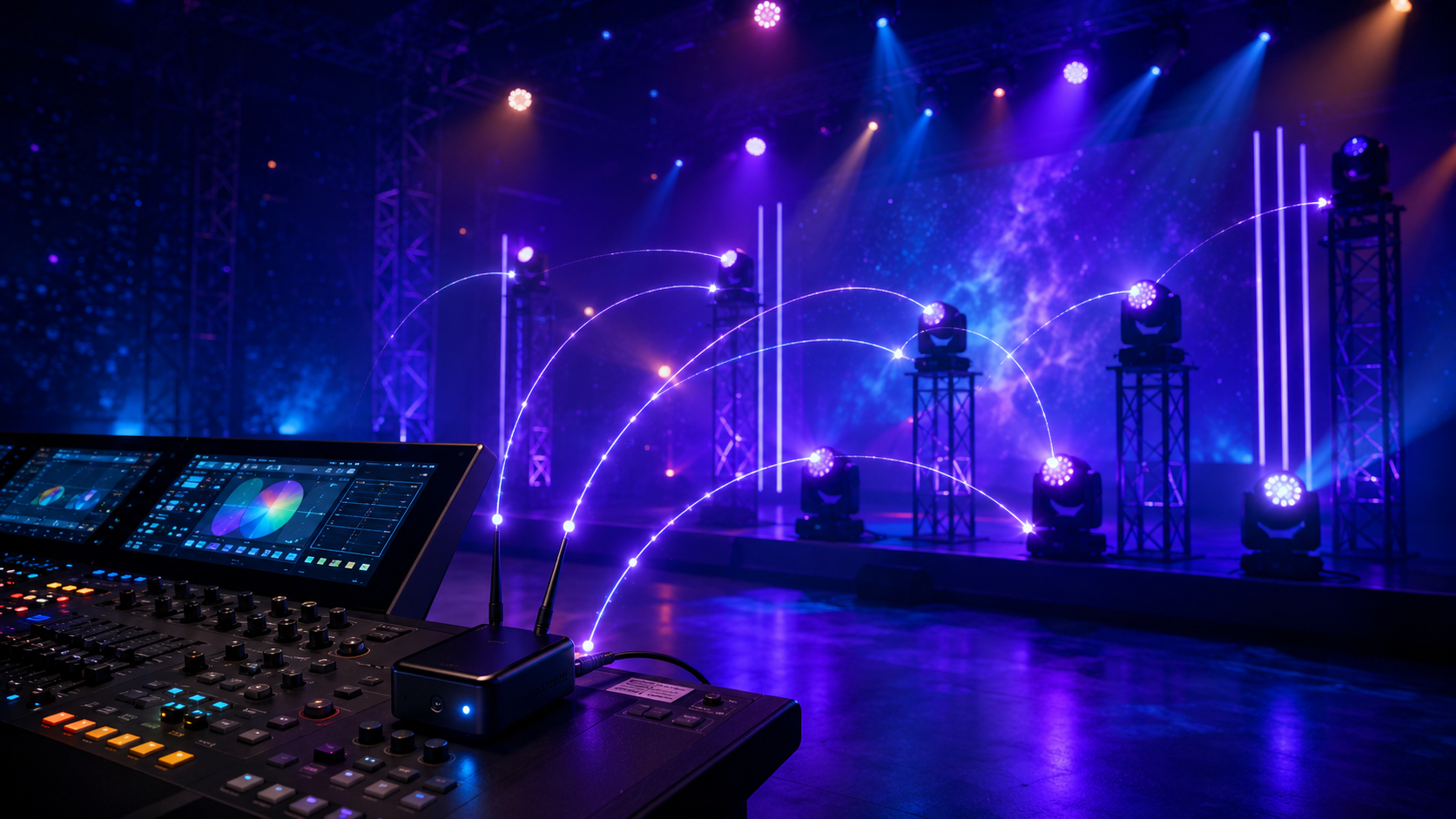
A wireless DMX system normally includes a transmitter, one or more receivers, and lighting fixtures. The dmx lighting controller sends DMX data to the transmitter through a standard DMX cable. The transmitter converts the DMX signal into wireless data and sends it to receivers. The receivers then output DMX data to fixtures or communicate directly with built-in wireless modules.
The lighting operator still programs the show in the normal way. The stage lighting control panel controls dimmer, color, pan, tilt, gobo, zoom, focus, prism, strobe, macro effects, and other fixture channels. Wireless DMX does not change the creative programming logic. It simply changes how the control signal travels from the console to the fixture.
This is one reason why wireless DMX is easy for lighting technicians to adopt. They do not need to learn a completely new control language. They still use DMX addresses, fixture profiles, scenes, chases, cues, and playback controls. The main difference is signal transmission.
For example, a lighting designer may connect a dmx lighting controller to a wireless transmitter near the control booth. Battery PAR lights around the venue receive wireless DMX and change colors according to the programmed scenes. Moving heads on truss may still use wired DMX, while decorative uplights use wireless DMX. This hybrid system is common and practical.
Wireless DMX can also be used as a bridge. If running a DMX cable from the control area to a remote lighting position is difficult, a wireless transmitter and receiver pair can replace that long cable. From the receiver, a short DMX cable can connect to several fixtures in a small chain. This method reduces long cable runs while still allowing multiple fixtures to be controlled.
A professional system should be planned with clear addressing, proper grouping, and backup thinking. Wireless receivers should be labeled. Battery fixtures should be grouped according to area. The operator should know which transmitter controls which fixtures. In larger systems, documentation becomes important.
8. Benefits for Rental Companies and Event Professionals
Rental companies are among the biggest beneficiaries of wireless dmx stage lighting. Their work is often time-sensitive. They need to load equipment, transport it, install it, test it, operate it, remove it, and prepare for the next event. Any technology that saves setup time and reduces cable complexity can bring real business value.
Wireless DMX helps rental companies in several ways.
It reduces installation time. Fewer signal cables mean faster setup. Technicians can spend more time focusing on fixture position, safety, and show quality.
It reduces cable costs and maintenance. DMX cables can be damaged, lost, tangled, or worn out. Wireless systems do not eliminate cables completely, but they can reduce the number of long signal cables required.
It improves event appearance. Clean setups look more professional, especially for weddings, luxury events, exhibitions, and corporate shows.
It increases flexibility. Rental companies can adapt quickly to venue changes. If the client changes the stage layout or adds a lighting area, wireless DMX can make adjustments easier.
It improves safety. Fewer floor cables mean fewer trip hazards and less need for cable covers in audience areas.
It supports battery-powered inventory. Battery lights with wireless DMX are highly attractive to event planners because they are quick, clean, and versatile.
For sales teams, these benefits are also easy to communicate to customers. Instead of only talking about technical parameters, they can explain practical value: faster setup, cleaner venue, flexible placement, reduced labor, and professional control.
9. Benefits for Outdoor Events and Temporary Installations
Outdoor events often create special challenges for lighting control. There may be long distances between the control area and lighting positions. The ground may be uneven. Cable protection may be difficult. Weather may create additional safety concerns. Temporary structures may not allow easy cable routing.
Wireless DMX can make outdoor lighting more practical. For example, lights can be placed around a garden, building facade, outdoor stage, entrance path, pool area, festival zone, or exhibition space without running long DMX cables across the entire site.
When used with battery-powered fixtures, the system becomes even more convenient. A team can place uplights around an outdoor wedding area or product launch venue without searching for power outlets. The stage lighting control panel can still control color scenes, brightness, fades, and effects from one location.
However, outdoor use also requires careful planning. Wireless equipment should be suitable for the environment. Fixtures may need waterproof ratings. Power and charging plans must be prepared. Antennas should be positioned properly. Long-distance control should be tested before the event begins.
Outdoor wireless DMX should not be treated as magic. It is a professional tool. When used correctly, it can solve many problems. When used carelessly, it may create new risks. Good planning, testing, and equipment choice are the keys to success.
10. How to Choose a Wireless DMX System
When choosing a wireless DMX system, lighting professionals should consider several important factors.
Signal stability should come first. A wireless system must be reliable during the show. Look for systems with strong anti-interference ability, frequency hopping technology, stable pairing, and low latency.
Transmission distance should match the application. A small indoor venue does not need the same range as a large outdoor festival. Choose based on real project needs.
Compatibility is important. The system should work smoothly with your dmx lighting controller, fixtures, receivers, and stage lighting control panel. Standard DMX input and output connections are useful for flexible setups.
Battery fixture support should be considered. If you plan to create a true wireless setup, choose fixtures that support both wireless DMX and battery power.
Ease of use matters. Rental teams need quick pairing, clear indicators, strong connectors, and simple troubleshooting.
Build quality is also important. Professional lighting equipment is often transported, installed, removed, and reused many times. Durable housing, stable antennas, and reliable connectors are valuable.
Finally, after-sales support should not be ignored. A good supplier should help with setup guidance, troubleshooting, spare parts, and technical questions.
11. Practical Setup Tips for Better Wireless DMX Performance
To get better results from wireless dmx stage lighting, users should follow practical setup habits.
Place the transmitter in a high and open position when possible. Avoid hiding it behind metal objects, LED screens, or thick walls.
Keep antennas clear. Antenna direction and placement can affect signal performance.
Reduce unnecessary obstacles. A clear signal path usually improves stability.
Test before the show. Do not wait until the audience arrives to check wireless performance.
Use proper DMX addressing. Wireless does not solve address mistakes. Make sure every fixture has the correct address and mode.
Group fixtures logically. For example, put wedding uplights, stage wash lights, and decorative lights into clear control groups.
Check battery levels. True wireless setups depend on battery readiness.
Prepare backup options. For important shows, backup receivers, cables, or alternative signal paths can help reduce risk.
Avoid overcomplicating the system. Use wireless where it brings value. Use wired DMX where it is more practical.
These simple habits can make wireless DMX more stable and professional.
12. The Future of Modern Stage Lighting Control
Modern stage lighting control is moving toward flexibility, integration, and intelligent operation. Wireless DMX is part of this trend. Lighting systems are becoming easier to deploy, easier to control, and more adaptable to different venues.
In the future, more fixtures will likely include built-in wireless control, battery power, app support, RDM functions, improved frequency management, and smarter diagnostics. Lighting technicians will be able to monitor fixture status, battery level, signal strength, temperature, and operating mode more easily.
For users, the goal is simple: more creative freedom with less installation complexity. A lighting designer should be able to focus on the visual story, not only on cable routing. A rental company should be able to serve more events efficiently. A venue should be able to change layouts without rebuilding the entire control system.
Wireless DMX will continue to play an important role in this development. Whether using 2.4G technology, UHF technology, or hybrid systems, the core value remains the same: stable control, flexible placement, and professional lighting performance.
Conclusion
The freedom of wireless DMX is not only about removing cables. It is about changing the way stage lighting systems are planned, installed, and controlled. With frequency hopping technology, wireless signals can remain more stable in complex interference environments. With battery-powered fixtures, lighting professionals can achieve true wireless operation: wireless signal plus battery power. With proper distance testing, users can compare 2.4G and UHF technologies and choose the right solution for each project.
For modern events, wireless dmx stage lighting offers speed, flexibility, clean installation, and creative freedom. A reliable dmx lighting controller and a well-planned stage lighting control panel can help lighting teams control fixtures smoothly across different venues and applications.
As live events, entertainment technology, and architectural lighting continue to develop, wireless DMX will become an even more valuable tool for professional lighting users. The best results come from understanding the technology, choosing the right equipment, testing carefully, and applying wireless control where it creates real value.



Blue Sea Lighting is an enterprise with rich experience in the integration of industry and trade in stage lighting and stage special effects related equipment. Its products include moving head lights, par lights, wall washer lights, logo gobo projector lights, power distributor, stage effects such as electronic fireworks machines, snow machines, smoke bubble machines, and related accessories such as light clamps.
Quick Links
For more questions subscribe to our email