The rapid development of LED technology has completely transformed the stage lighting industry. From concerts and theater productions to television studios and live-streaming events, LED fixtures are now everywhere. Compared with traditional halogen and discharge lamps, LED stage lights consume less energy, generate less heat, and provide more creative color possibilities.
However, brightness alone is no longer enough when evaluating professional lighting fixtures. Modern lighting designers care deeply about how accurately a fixture reproduces colors. This is where CRI, TLCI, and TM-30 become extremely important.
Many buyers see specifications such as “CRI 95+” or “TLCI 90” in product descriptions but may not fully understand what these values mean. In reality, these standards directly influence skin tones, costume appearance, stage atmosphere, broadcast image quality, and audience experience.
Professional manufacturers such as Blue Sea Lighting continue improving LED technology to meet the growing demand for better color rendering in stage and studio environments.
This article will explain CRI, TLCI, and TM-30 in simple and practical language, helping lighting professionals and beginners understand how these measurements affect real-world performances.
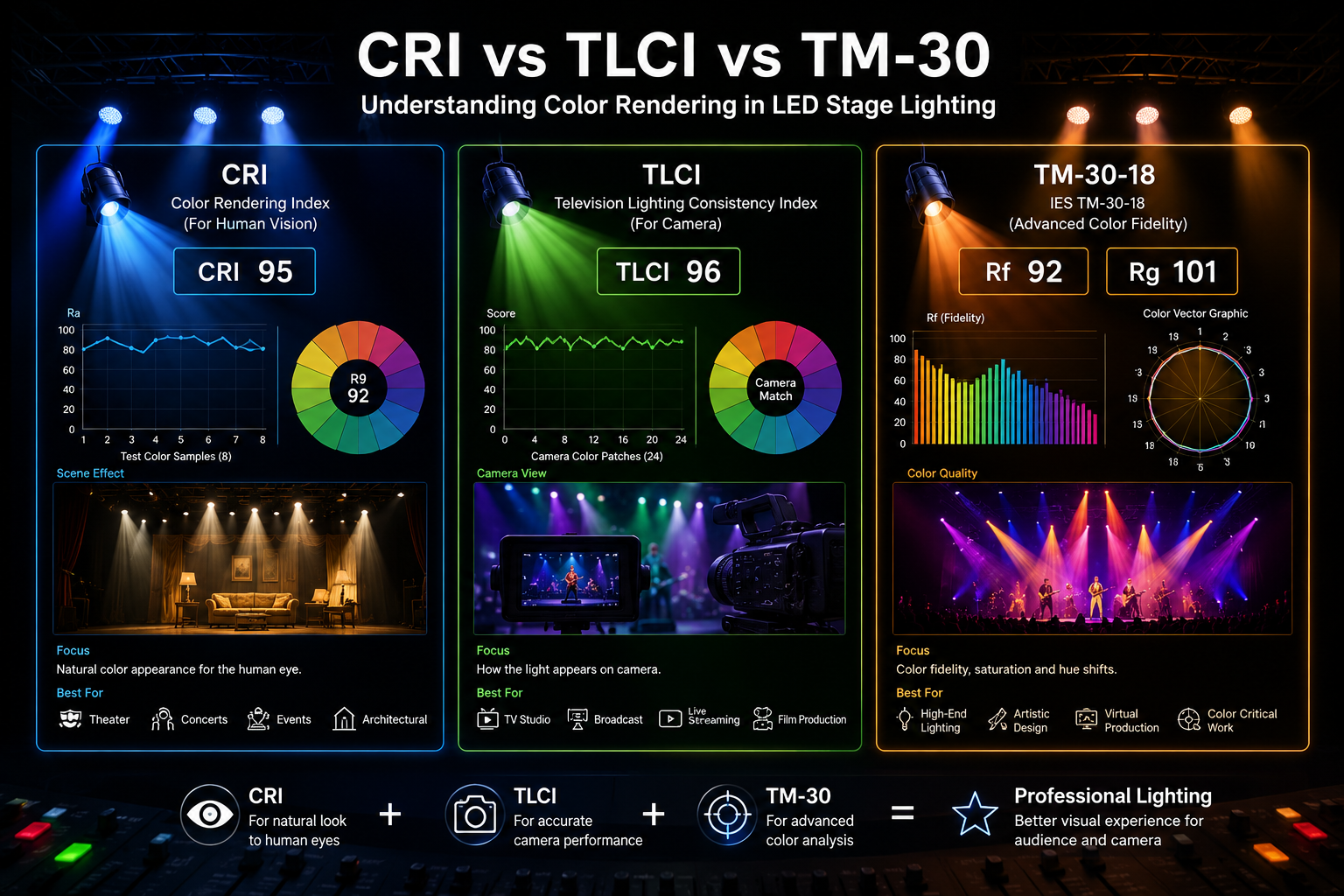
Why Color Accuracy Matters in Stage Lighting
Imagine a live concert where the singer’s face appears pale green on camera. Or a theater performance where red costumes look dull and lifeless under the lights. Even if the fixtures are extremely bright, poor color rendering can ruin the visual experience.
Color accuracy matters because lighting affects how audiences see objects, people, scenery, and emotions. In stage applications, lighting designers use color to create mood, storytelling, and visual impact.
High-quality LED fixtures should:
Reproduce skin tones naturally
Display costumes accurately
Maintain vivid scenic colors
Work well for both live audiences and cameras
Reduce unwanted color shifts
This is why color evaluation standards are essential.
What Is CRI?
CRI stands for Color Rendering Index.
It is one of the oldest and most widely used standards for measuring how accurately a light source reproduces colors compared with natural sunlight or an ideal reference light.
CRI values range from 0 to 100.
CRI 100 = Perfect color rendering
CRI 90+ = Excellent color accuracy
CRI 80–89 = Good quality
CRI below 80 = Poor color reproduction
The higher the CRI, the more natural colors appear under the light source.
How CRI Works
CRI compares how eight standard color samples appear under a test light source versus a reference source.
If the colors look very similar, the CRI score is high.
For example:
A CRI 95 LED fixture makes skin tones appear realistic
A CRI 70 fixture may make faces appear gray or unnatural
In stage lighting, high CRI is especially important for:
Theater performances
TV studios
Fashion shows
Photography
Live streaming
Corporate events
Advantages of High CRI Fixtures
High CRI lighting provides many benefits:
Better Skin Tones
Actors, presenters, and performers appear more natural under high CRI lighting.
Improved Costume Visibility
Fabric textures and colors become clearer and richer.
More Professional Broadcast Results
High CRI fixtures help cameras capture accurate images.
Better Audience Experience
The audience perceives scenes more vividly and comfortably.
Limitations of CRI
Although CRI is useful, it has several weaknesses.
It Uses Only Eight Test Colors
Modern objects contain far more complex colors than the original CRI system measures.
It Does Not Evaluate Saturation Well
Two fixtures with the same CRI may still produce very different visual results.
It Was Developed Before Modern LEDs
CRI was created long before advanced LED technology existed.
Because of these limitations, newer evaluation systems were developed.
What Is TLCI?
TLCI stands for Television Lighting Consistency Index.
Unlike CRI, which focuses on human vision, TLCI evaluates how lighting appears on television and digital cameras.
This is extremely important because cameras see colors differently than human eyes.
A light source may look acceptable to people in a venue but appear terrible on camera.
TLCI helps broadcasters and filmmakers predict camera performance.
TLCI Score Range
TLCI also uses a 0–100 scale.
TLCI 85+ = Good broadcast quality
TLCI 90+ = Excellent television performance
TLCI 95+ = Professional studio quality
High-end studio fixtures often target TLCI scores above 95.
Why TLCI Matters for Modern Productions
Today, many stage performances are simultaneously:
Broadcast live
Streamed online
Recorded for social media
Captured by professional cameras
Poor lighting quality can create major camera issues:
Unnatural skin tones
Excessive color correction needs
Inconsistent white balance
Difficult post-production editing
High TLCI lighting reduces these problems significantly.
Modern production companies increasingly prefer fixtures with both high CRI and high TLCI values.
Practical Example of TLCI
Imagine two LED fixtures:
Fixture
CRI
TLCI
Fixture A | 95 | 72 |
Fixture B | 93 | 96 |
Although Fixture A has a slightly higher CRI, Fixture B will usually perform much better on camera because of its superior TLCI rating.
This is why television studios prioritize TLCI.
What Is TM-30?
TM-30 is the newest and most advanced color evaluation standard.
It was developed by the Illuminating Engineering Society (IES) to solve many weaknesses of CRI.
TM-30 provides a much more detailed analysis of color rendering.
Instead of using only eight color samples, TM-30 evaluates 99 different colors.
This creates a far more realistic measurement of how lighting behaves in real environments.
Manufacturers like Blue Sea Lighting increasingly adopt TM-30 standards in professional-grade LED fixtures for theaters, broadcast studios, and large-scale productions.
The Two Main Components of TM-30
TM-30 introduces two important measurements:
Rf — Fidelity Index
Rf measures how accurately colors are reproduced.
It is similar to CRI but more advanced.
Rg — Gamut Index
Rg measures color saturation.
Rg above 100 = More saturated colors
Rg below 100 = Less saturated colors
This helps designers understand whether colors will appear vivid or muted.
Why TM-30 Is More Advanced
TM-30 provides deeper information than CRI.
It evaluates:
Color accuracy
Color saturation
Hue shifts
Individual color performance
Overall visual balance
This makes TM-30 extremely useful for professional lighting designers.
TM-30 Color Vector Graphics
One unique feature of TM-30 is its color vector graphic.
This visual chart shows:
Which colors become oversaturated
Which colors lose intensity
Which hues shift unexpectedly
Lighting engineers can quickly identify fixture strengths and weaknesses.
Comparing CRI, TLCI, and TM-30
Here is a simple comparison:
Standard
Main Purpose
Focus
CRI | Human vision | Basic color accuracy |
TLCI | Camera performance | Broadcast image quality |
TM-30 | Advanced analysis | Detailed color rendering |
Each standard serves a different purpose.
Which Standard Is Most Important?
The answer depends on the application.
For Theater Lighting
CRI and TM-30 are very important because audiences watch directly with their eyes.
For Television Studios
TLCI is critical because cameras dominate the workflow.
For Concert Touring
A balance of all three standards is ideal.
For Live Streaming
High TLCI and TM-30 performance are increasingly important.
Why High CRI Alone Is Not Enough
Many buyers still focus only on CRI values.
However, this can be misleading.
Two fixtures may both advertise CRI 95, but:
One may perform poorly on camera
One may oversaturate reds
One may distort skin tones
TM-30 and TLCI provide additional information that CRI cannot.
This is why modern professionals evaluate all three standards together.
The Relationship Between LEDs and Color Rendering
Early LED fixtures often suffered from poor color quality.
Common problems included:
Green color shifts
Weak red reproduction
Harsh skin tones
Inconsistent white balance
Modern LED technology has improved dramatically.
Advanced chip design, phosphor coatings, and optical systems now allow professional fixtures to achieve:
CRI 95+
TLCI 95+
Excellent TM-30 results
This improvement has helped LEDs dominate professional entertainment lighting.
How Lighting Designers Use These Standards
Professional lighting designers study fixture specifications carefully.
They consider:
Camera requirements
Audience viewing distance
Stage colors
Costume materials
Broadcast conditions
Streaming platforms
Different productions require different priorities.
For example:
Fashion shows need excellent skin tone rendering
Rock concerts may prioritize saturated visual effects
News studios require extremely accurate white light
Understanding R9 Values
When discussing CRI, many professionals also mention “R9.”
R9 measures strong red color reproduction.
This is important because human skin contains red tones.
A fixture may have:
High overall CRI
Poor R9 performance
In that case, faces can still appear unnatural.
High-quality broadcast fixtures often feature:
CRI above 95
R9 above 90
Common Misunderstandings About CRI
Higher CRI Does Not Always Mean Better Visual Impact
Sometimes lighting designers intentionally use fixtures with stronger saturation for artistic effects.
CRI Does Not Measure Brightness
Brightness and color rendering are different characteristics.
CRI Alone Cannot Predict Camera Performance
This is why TLCI exists.
How TM-30 Helps Future Lighting Design
TM-30 is becoming increasingly important because it better matches modern lighting needs.
Advantages include:
More accurate testing
Better prediction of visual appearance
Improved LED evaluation
Enhanced fixture comparison
Many experts believe TM-30 may eventually replace CRI as the industry standard.
Choosing the Right LED Stage Fixture
When selecting professional stage lighting, buyers should evaluate:
CRI
Look for CRI 90 or higher.
TLCI
Choose TLCI 90+ for broadcast work.
TM-30
Review Rf and Rg values for deeper analysis.
Application Needs
Different environments require different lighting characteristics.
The Importance of Testing Fixtures in Real Conditions
Specifications alone cannot tell the full story.
Professional lighting teams often test fixtures in real environments before purchasing large quantities.
They evaluate:
Skin tone rendering
Camera compatibility
Costume appearance
Scenic color accuracy
White balance behavior
Real-world testing remains essential.
Future Trends in LED Color Quality
LED technology continues improving rapidly.
Future developments may include:
AI-assisted color calibration
Dynamic spectrum adjustment
Smarter camera integration
Improved phosphor technology
Advanced TM-30 optimization
As live streaming and virtual production continue growing, accurate color rendering will become even more important.
Professional manufacturers such as Blue Sea Lighting continue investing in high-performance LED systems that meet the demanding standards of modern entertainment productions.
Conclusion
CRI, TLCI, and TM-30 are essential standards for understanding LED stage lighting quality.
CRI measures basic color rendering for human vision.
TLCI evaluates how fixtures perform on camera.
TM-30 provides a more advanced and detailed analysis of color fidelity and saturation.
No single standard tells the entire story. Professional lighting designers increasingly combine all three measurements when selecting fixtures for concerts, theaters, television studios, live streaming, and event productions.
As LED technology evolves, understanding these standards becomes increasingly important for achieving professional visual results. Whether you are a lighting designer, rental company, theater technician, or event organizer, learning the differences between CRI, TLCI, and TM-30 will help you make smarter lighting decisions and create more impressive visual experiences.



Blue Sea Lighting is an enterprise with rich experience in the integration of industry and trade in stage lighting and stage special effects related equipment. Its products include moving head lights, par lights, wall washer lights, logo gobo projector lights, power distributor, stage effects such as electronic fireworks machines, snow machines, smoke bubble machines, and related accessories such as light clamps.
Quick Links
For more questions subscribe to our email