As concerts, music festivals, clubs, touring productions, outdoor events, and entertainment venues continue to demand stronger visual effects, professional strobe lighting is becoming much more than a simple flashing light. Modern stage designers want fixtures that can create intense white flashes, colorful wash effects, pixel animations, chasing patterns, and large-scale geometric lighting structures within the same system.
To demonstrate how this type of fixture performs in a real environment, we carried out a practical showroom test of a splicable IP65 waterproof outdoor 864pcs 96-segment LED strobe bar light.
Rather than relying on computer rendering or promotional graphics, the test was photographed inside a real professional lighting showroom. Multiple bar fixtures were placed on the floor in different directions, stage haze was introduced, and several color looks were tested.
The three showroom photographs show three very different visual conditions: a strong red atmosphere, a blue-purple and pink mixed effect, and an intense white-light output.
Together, these real images provide a clear idea of how the fixture can be used as both a color effect light and a high-impact strobe.
Powerful Red Lighting for High-Energy Stage Moments
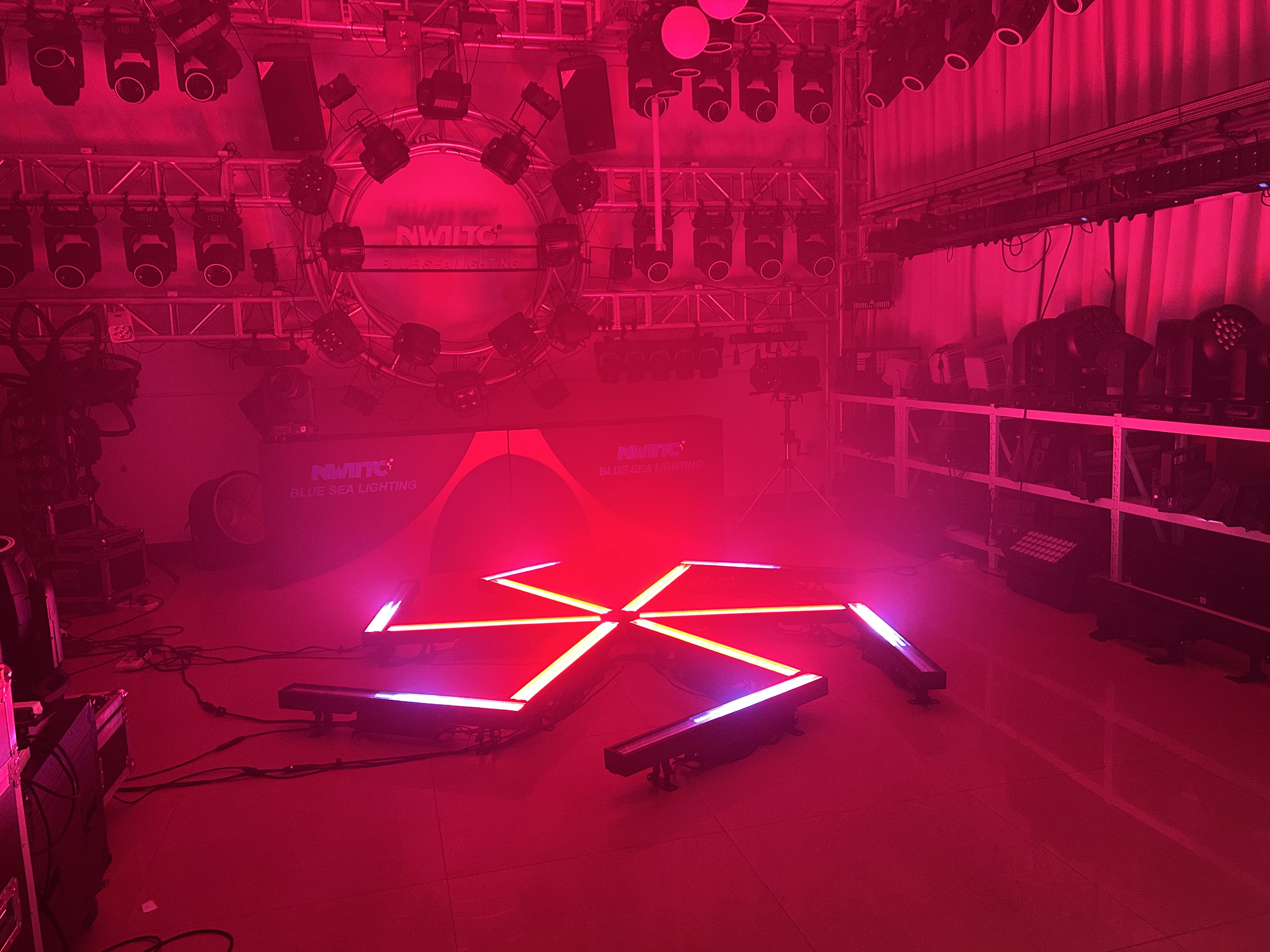
The first showroom photograph shows the bar lights operating in a strong red environment.
Several fixtures are arranged around a central position to create a radial lighting pattern. The red output fills the lower part of the showroom, while the haze in the room makes the overall atmosphere much more visible.
This type of look is especially useful for EDM events, DJ performances, concerts, festivals, nightclubs, and high-energy stage moments.
A professional strobe fixture is often used when a show needs an immediate visual change. When the music reaches a drop, a drum hit, a transition, or a climax, a powerful lighting burst can dramatically increase the feeling of energy in the venue.
Traditional strobe lights are mainly associated with bright white flashes. However, a modern RGB and white strobe bar gives designers far more possibilities.
Instead of waiting for a short climax before using the fixture, a lighting programmer can use red, blue, green, purple, or mixed colors during normal sections of the performance. When a stronger impact is required, the white strobe LEDs can then be introduced.
This makes the fixture useful throughout more of the show.
For example, a programmer may create a deep red stage look during a buildup, introduce moving RGB segment effects as the music becomes stronger, and finally trigger bright white flashes during the main drop.
The result is a more complete visual sequence rather than a single isolated strobe effect.
RGB Color Effects Add More Creative Possibilities
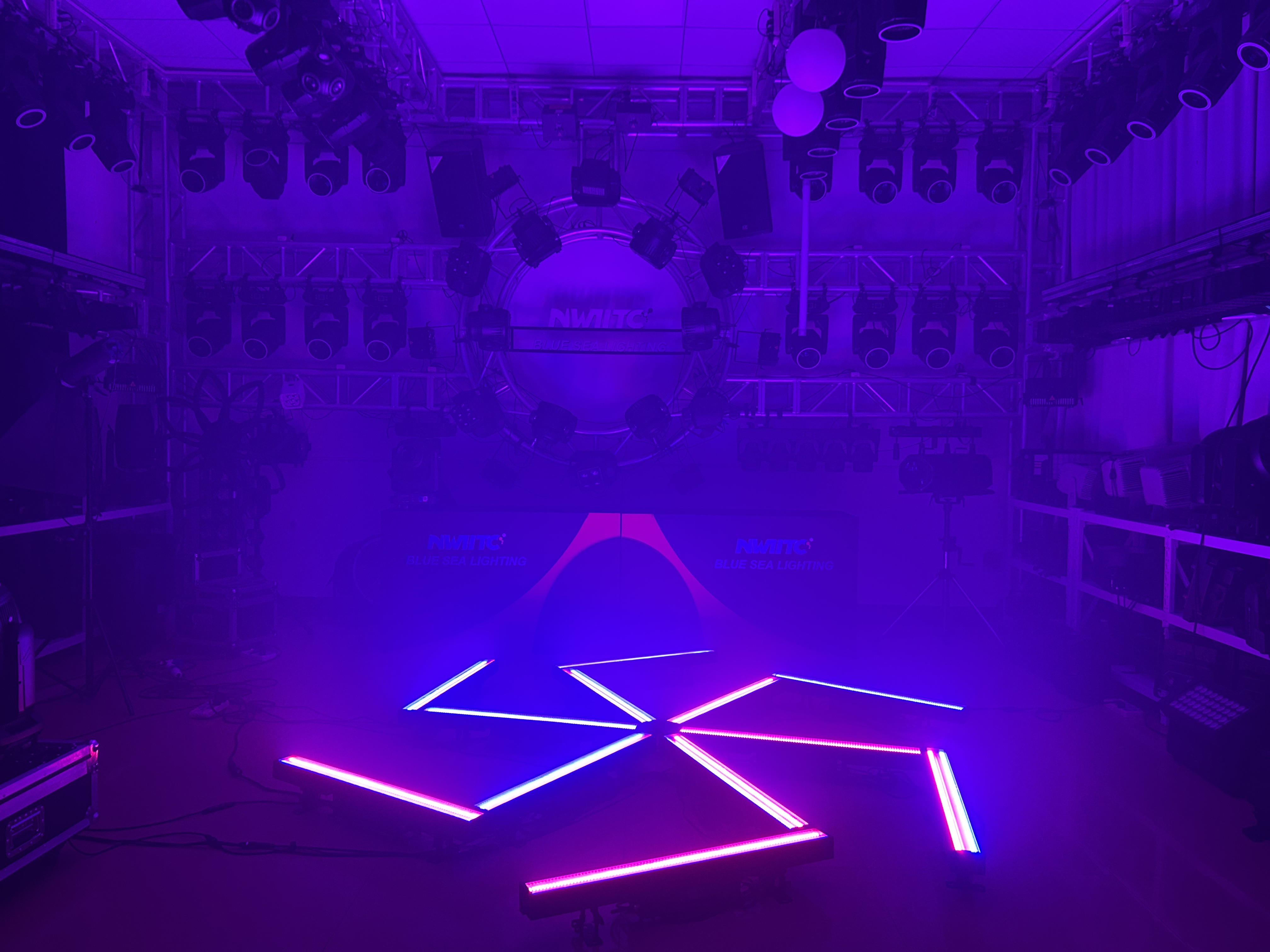
The second showroom photograph demonstrates a completely different visual style.
Instead of one dominant red color, the fixtures display blue, purple, pink, and brighter contrasting sections. The haze makes these colors visible throughout the lower part of the showroom and helps show how multiple bars can work together as one visual system.
This photograph is important because it demonstrates that the fixture should not be considered only as a traditional strobe.
The long housing and segmented LED arrangement make it suitable for color effects, visual lines, chases, and pixel-style programming.
In a large concert, several bars can be installed horizontally behind the performers. The programmer can then create movement from left to right, right to left, or from the center outward.
They can also be installed vertically to create illuminated columns.
Another option is to place them diagonally, allowing the lighting system itself to become part of the stage geometry.
The showroom arrangement provides a simple example of this idea. By placing the bars at different angles around a central point, the fixtures create a star-like or radial shape.
A larger production could apply the same principle with many more fixtures and create a much bigger structure.
This flexibility can be particularly valuable to rental companies.
Rental equipment must work for many different customers and different event formats. One week the fixtures may be used at an electronic music festival, and the next week they may be installed for a corporate event, club show, or touring concert.
A fixture that can provide both subtle color effects and powerful strobe output therefore has a wider range of possible applications.
Bright White Output for Classic Strobe Impact

The third showroom image shows the fixtures operating with bright white output.
Compared with the colored photographs, the white-light effect creates a much more direct and aggressive visual impact. In the haze-filled showroom, the bright sections of the bars are clearly visible and create a strong burst of light around the fixture positions.
This type of white strobe effect remains an essential part of professional entertainment lighting.
During concerts and electronic music performances, white strobe bursts are often synchronized with drums, bass hits, transitions, or major musical moments.
When multiple fixtures operate at the same time, the entire stage can change visually within a fraction of a second.
However, the long linear design offers another advantage.
A traditional square strobe creates a concentrated area of light. A bar-shaped fixture creates a visible line.
When many bars are installed together, these lines can become part of the stage architecture.
They may be mounted on trusses, placed around LED screens, installed behind a DJ booth, arranged along stage edges, or combined into large geometric patterns.
That means the fixture can contribute to the visual design even when it is not producing rapid flashes.
96-Segment Control for Detailed Programming
One of the key concepts behind this product is segmented control.
A long LED bar becomes much more useful when the programmer can treat different areas as separate visual zones.
Instead of simply turning the complete fixture on and off, the lighting designer can create motion inside the bar itself.
For example, an effect can travel from one end of the fixture to the other. Another effect can begin in the center and move toward both ends. Alternating sections can flash in different patterns, while several fixtures can be synchronized to create larger animations.
Once multiple bars are combined, these effects become even more interesting.
Imagine a festival stage with rows of fixtures behind the main LED screen. A chase could begin on the left side of the stage and move across every bar toward the right.
Another sequence could begin at the center and expand outward.
During quieter music sections, the bars could remain in a low-intensity RGB look. During the climax, the complete system could switch to intense white flashes.
This programming flexibility allows a relatively simple linear fixture to produce many different visual styles.
RGB and White LEDs in One Fixture
According to the product specifications, the fixture has a rated power consumption of 350W and combines RGB LEDs with dedicated white LEDs. The published configuration lists 572 pieces of 5050 RGB 0.5W LEDs and 288 pieces of 3535 3W white LEDs.
The combination of RGB and dedicated white sources is practical for professional stage applications because the two systems can perform different jobs.
RGB LEDs provide color.
They can create red, blue, green, purple, pink, cyan, and many mixed-color looks. They are useful for stage washes, pixel effects, chases, and visual backgrounds.
The dedicated white LEDs are designed to create the stronger white impact expected from a professional strobe.
By placing both functions in one fixture, designers can reduce the need to install separate color bars and separate strobe units in the same position.
This can make the stage design cleaner and can also simplify programming.
A single fixture may provide soft color during one part of the performance and a completely different high-energy white effect only a few seconds later.
Multiple DMX Modes for Simple or Advanced Shows
Professional lighting projects can vary greatly in scale.
A small club may need only basic control over color, intensity, and strobe speed. A touring concert or festival may require much more detailed control over individual segments.
For this reason, flexible DMX channel options are important.
The published product information lists Master-Slave, Auto, and DMX512 network protocol control, together with multiple DMX channel configurations. A touch-sensitive color display is also provided for fixture setup and menu operation.
This allows different users to choose a control mode that matches their requirements.
A simple mode can reduce channel consumption when many fixtures are connected.
More detailed modes can provide greater access to segmented effects when a professional console and larger DMX or network infrastructure are available.
For rental companies, this flexibility is useful because the same fixtures may be supplied to customers with very different control systems and levels of programming experience.
IP65 Protection for Outdoor Entertainment Projects
Outdoor events are now a major part of the professional entertainment market.
Music festivals, city celebrations, sports events, cultural performances, outdoor concerts, product launches, and temporary stages often require equipment that can operate in more demanding environments.
The product is specified with an IP65 waterproof rating and is designed for indoor and outdoor stage applications.
For rental businesses, using IP-rated fixtures can also improve equipment flexibility.
Instead of maintaining one complete inventory for indoor use and another for outdoor use, IP65 products may be deployed across a wider variety of projects.
That can increase utilization and simplify equipment planning.
Of course, an IP65 fixture should still be installed professionally. Electrical connections, rigging, safety cables, power distribution, local regulations, and severe weather conditions all need to be considered when designing an outdoor lighting system.
Water resistance is one part of a complete safe installation rather than a replacement for proper event engineering.
Splicable Bar Design Supports Large Visual Structures
Another important advantage is the splicable concept.
A single bar can already create a useful visual line, but the creative potential becomes much larger when many fixtures are installed together.
Lighting designers can arrange them in horizontal rows, vertical columns, diagonal lines, squares, frames, stars, radial patterns, or custom geometric structures.
They can also be positioned around video screens or DJ booths.
This creates an interesting combination of lighting and scenic design.
During one part of a show, the bars may function as colored architectural lines.
During another section, their segments can begin moving and chasing.
At the climax, the same structure can suddenly become a large white strobe system.
This ability to transform the same physical installation through programming is increasingly valuable in modern stage design.
It also means a rental company can use the same stock of fixtures to build very different-looking stages.
Twenty bars could create one design for a club event, while forty or sixty could create a much larger visual structure for a festival.
The equipment remains the same, but the configuration changes with the project.
Approximately One-Meter Format for Practical Installation
The published dimensions are 997 × 160 × 190 mm, with a stated net weight of 8.5 kg.
A bar that is approximately one meter long is practical for many stage designs because it is large enough to create a clearly visible visual line while still allowing modular arrangements.
Designers can estimate the overall width of large structures relatively easily.
For example, several bars arranged in a row can quickly create a long lighting feature across a stage.
The same products can then be reconfigured vertically or diagonally for another event.
For touring and rental applications, modular dimensions also make it easier to develop repeatable rigging layouts and prepare show files in advance.
50,000-Hour Rated LED Lifespan
The product information lists an LED lifespan of 50,000 hours.
For professional equipment buyers, LED lifespan is relevant because stage fixtures may be used repeatedly across many events.
Rental companies in particular need equipment that can move from one production to another without frequent light-source replacement.
Actual service life always depends on operating conditions, temperature, maintenance, power quality, usage patterns, and other factors, but a long rated LED lifetime is an important part of the product's professional positioning.
Cooling also plays a role, and the published specifications identify air cooling as the fixture's cooling method.
Useful for Concerts, Festivals and Touring Systems
The versatility of the fixture allows it to fit many different types of entertainment projects.
For concerts, it can be installed behind musicians, around video walls, above the stage, or along the edge of the performance area.
For EDM festivals, large numbers of fixtures can be synchronized into powerful pixel and strobe systems.
For nightclubs and DJ venues, the RGB functions provide continuous color effects while the white LEDs are available for dramatic musical peaks.
For touring productions, the same fixtures can be reconfigured from venue to venue.
Corporate events can also use the bars in a different way.
Instead of rapid strobe effects, programmers can operate them at lower intensity and use selected RGB colors to match a company logo or event theme.
This demonstrates one of the strongest advantages of multifunction stage lighting: the same hardware can produce very different visual styles simply through programming.
Why Real Showroom Testing Matters
Professional lighting buyers often make decisions based on technical specifications, but specifications alone cannot communicate the complete visual experience of a fixture.
Brightness, color impression, haze interaction, apparent size, and the relationship between multiple fixtures are easier to understand through real photographs and demonstrations.
That is why showroom testing is valuable.
The three images in this article show genuine differences between red, mixed RGB, and white output.
The first image demonstrates how strongly one color can dominate the environment.
The second demonstrates the creative value of mixed colors.
The third shows the visual intensity that bright white output can produce in haze.
These are practical references for distributors, rental companies, lighting designers, and system integrators who want to understand how a long segmented strobe bar may look as part of a larger lighting system.
A Flexible Lighting Tool Rather Than a Single-Effect Fixture
Modern professional lighting equipment is increasingly expected to perform several jobs.
A moving head may combine beam, spot, and wash functions. A pixel wash may provide both stage illumination and animated effects. In the same way, a modern strobe bar can combine high-impact flashing, RGB color, segmented movement, and scenic visual lines.
This multifunction approach helps stage designers create more effects without filling every position with multiple different fixtures.
It also helps rental companies obtain more value from each item in their inventory.
The fixture can be used aggressively in a large EDM show or much more subtly in a corporate event.
The difference comes from programming.
That is an important reason why segmented RGB and white strobe bars have become useful tools in modern concerts and entertainment projects.
Designed for Professional Buyers Who Need Flexibility
For distributors and professional buyers, choosing a stage fixture is rarely based on only one specification.
They need to consider how easily the product can be demonstrated, how many applications it can serve, how flexible it is for customers, whether it can be used outdoors, how it fits into existing DMX systems, and whether multiple units can create a larger visual system.
This product combines several characteristics that address those requirements: a long linear form, RGB and white output, segmented control, different DMX modes, IP65 protection, and a modular installation concept.
That makes it relevant to stage-lighting distributors, rental companies, system integrators, production companies, clubs, concert venues, festival suppliers, and event professionals.
From a Single Bar to a Complete Stage Visual System
Perhaps the most interesting feature of this type of product is scalability.
One fixture can create a simple lighting line.
Four or eight fixtures can create a geometric shape.
Dozens of fixtures can become a complete visual background.
As the number of units increases, the same segmented programming concept can be expanded across the entire installation.
This means a production company can start with a relatively small quantity and develop larger configurations as project requirements grow.
For a rental business, this modular approach can also be commercially attractive because additional units expand the scale of possible projects without changing to a completely different product platform.
Conclusion
The real showroom photographs demonstrate how a professional LED strobe bar can produce very different effects from the same physical fixture.
The red test creates a strong and immersive atmosphere.
The blue, purple, and pink test shows the value of colorful segmented effects.
The white test demonstrates the intense visual impact expected from a professional strobe system.
Combined with IP65 protection, multiple control modes, RGB and dedicated white LEDs, a long linear format, and flexible multi-fixture arrangements, the product offers more than a traditional flash effect.
It can become an active part of the stage design.
For concerts, festivals, clubs, touring productions, rental fleets, outdoor events, and other professional entertainment projects, that flexibility can be extremely valuable.



Blue Sea Lighting is an enterprise with rich experience in the integration of industry and trade in stage lighting and stage special effects related equipment. Its products include moving head lights, par lights, wall washer lights, logo gobo projector lights, power distributor, stage effects such as electronic fireworks machines, snow machines, smoke bubble machines, and related accessories such as light clamps.
Quick Links
For more questions subscribe to our email